

Can a Rising Film Evaporator be used for continuous evaporation?
May 22, 2025
Leave a message
As a supplier of Rising Film Evaporators, I often encounter inquiries about the suitability of our equipment for continuous evaporation processes. In this blog post, I'll delve into the technical aspects of Rising Film Evaporators and explain whether they can be effectively used for continuous evaporation.
Understanding Rising Film Evaporators
Before discussing continuous evaporation, let's first understand the basic principles of a Rising Film Evaporator. A Rising Film Evaporator is a type of evaporator where the liquid to be evaporated is fed into the bottom of a vertical tube bundle. As steam or a heating medium is applied to the outside of the tubes, the liquid inside the tubes begins to boil. The vapor generated creates a driving force that causes the liquid to rise up the tubes in the form of a thin film. This thin film provides a large surface area for heat transfer, which is crucial for efficient evaporation.
The design of a Rising Film Evaporator offers several advantages. It has a relatively short residence time for the liquid, which is beneficial for heat - sensitive materials as it minimizes the exposure to high temperatures. The upward flow of the liquid and vapor also helps in self - cleaning to some extent, reducing the risk of fouling on the tube surfaces.
Can a Rising Film Evaporator be Used for Continuous Evaporation?
The answer is yes, a Rising Film Evaporator can be used for continuous evaporation, and it is widely employed in various industries for this purpose. Here are the key factors that make it suitable for continuous operation:
1. Continuous Feed and Discharge
In a continuous evaporation process, a steady flow of the feed liquid needs to be introduced into the evaporator, and the concentrated product and the vapor need to be continuously removed. Rising Film Evaporators are designed to handle this continuous flow. The feed liquid can be continuously pumped into the bottom of the tube bundle at a controlled rate. As the liquid rises up the tubes and evaporates, the concentrated liquid can be continuously discharged from the top of the tubes, while the vapor is also continuously removed from the system.
2. Stable Heat Transfer
For continuous evaporation, stable heat transfer is essential to maintain a consistent evaporation rate. Rising Film Evaporators provide a stable heat transfer mechanism. The thin film of liquid on the tube walls ensures a high heat transfer coefficient. As long as the heating medium (such as steam) is supplied at a constant temperature and flow rate, the heat transfer rate remains relatively stable, which is crucial for continuous operation.

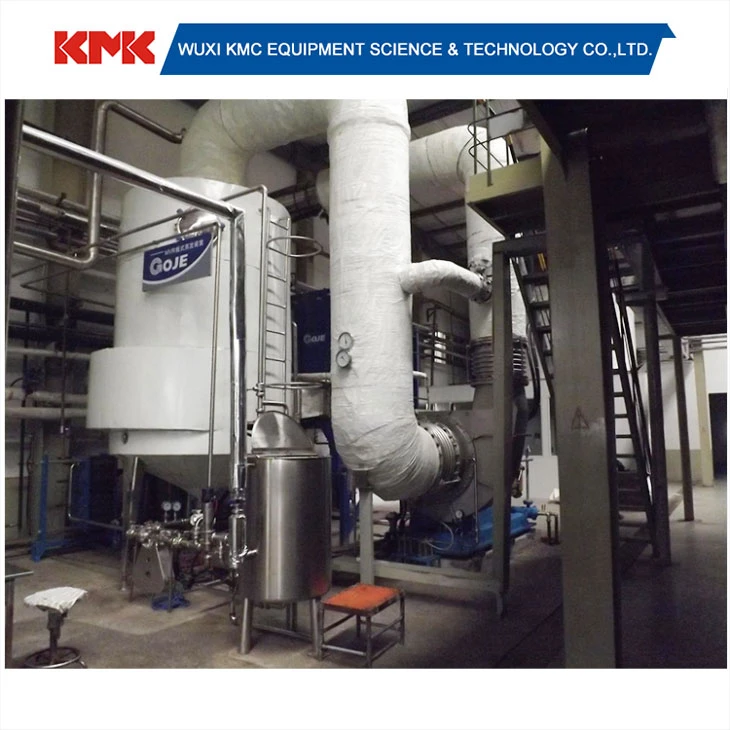
3. Adaptability to Different Feed Conditions
Rising Film Evaporators can handle a wide range of feed compositions and flow rates. Whether the feed is a dilute solution or a moderately concentrated liquid, the evaporator can be adjusted to achieve the desired evaporation. This adaptability makes it suitable for continuous processes where the feed conditions may vary slightly over time.
Applications of Rising Film Evaporators in Continuous Evaporation
Food and Beverage Industry
In the food and beverage industry, Rising Film Evaporators are used for continuous concentration of fruit juices, milk, and other liquid food products. For example, when concentrating orange juice, a continuous flow of fresh orange juice is fed into the evaporator. The water is evaporated, and the concentrated juice is continuously collected. The short residence time in the evaporator helps to preserve the flavor and nutritional value of the juice.
Chemical Industry
In the chemical industry, Rising Film Evaporators are used for continuous evaporation of various chemical solutions. For instance, in the production of sodium hydroxide solutions, the dilute solution can be continuously concentrated using a Rising Film Evaporator. The stable heat transfer and continuous operation capabilities of the evaporator ensure a consistent quality of the concentrated product.
Comparison with Other Evaporator Types
While Rising Film Evaporators are well - suited for continuous evaporation, it's important to compare them with other types of evaporators, such as [Centrifugal Film Evaporator](https://www.example.com/film - evaporator/centrifugal - film - evaporator.html) and [MVR Evaporator](https://www.example.com/film - evaporator/mvr - evaporator.html).
Centrifugal Film Evaporator
Centrifugal Film Evaporators use centrifugal force to create a thin film of liquid on a rotating surface. They offer extremely short residence times and high heat transfer coefficients. However, they are generally more complex and expensive to operate compared to Rising Film Evaporators. For applications where the feed material is highly heat - sensitive and requires very short processing times, a Centrifugal Film Evaporator may be preferred. But for many continuous evaporation processes where the heat - sensitivity is not extremely high, Rising Film Evaporators provide a more cost - effective solution.
MVR Evaporator
MVR (Mechanical Vapor Recompression) Evaporators are energy - efficient as they reuse the vapor generated during the evaporation process. They are suitable for large - scale continuous evaporation processes where energy savings are a major concern. Rising Film Evaporators can be combined with MVR technology to further enhance the energy efficiency of the continuous evaporation process. The Rising Film Evaporator provides the basic evaporation mechanism, while the MVR system helps to reduce the energy consumption by recompressing and reusing the vapor.
Considerations for Continuous Operation of Rising Film Evaporators
1. Feed Pre - treatment
Proper feed pre - treatment is crucial for the continuous operation of a Rising Film Evaporator. The feed should be free from solids and other contaminants that could cause fouling of the tube surfaces. Filtration and other pre - treatment steps may be required to ensure a smooth and continuous operation.
2. Monitoring and Control
Continuous operation requires strict monitoring and control of various parameters such as feed flow rate, heating medium temperature and flow rate, and product concentration. Automated control systems can be installed to maintain these parameters within the desired range and to ensure the stability of the evaporation process.
3. Maintenance
Regular maintenance is essential to keep the Rising Film Evaporator in good working condition. This includes cleaning the tube surfaces to prevent fouling, checking the seals and gaskets for leaks, and inspecting the pumps and other components for proper operation.
Conclusion
In conclusion, a Rising Film Evaporator is a viable option for continuous evaporation. Its ability to handle continuous feed and discharge, provide stable heat transfer, and adapt to different feed conditions makes it suitable for a wide range of industries. While it may not be the best choice for every application, especially when compared to specialized evaporators like Centrifugal Film Evaporators or energy - efficient MVR Evaporators, it offers a cost - effective and reliable solution for many continuous evaporation processes.
If you are considering a continuous evaporation process and are interested in learning more about our [Rising Film Evaporators](https://www.example.com/film - evaporator/rising - film - evaporator.html), we invite you to contact us for a detailed discussion. Our team of experts can help you determine if our equipment is the right fit for your specific needs and provide you with a customized solution.
References
- "Evaporation Technology" by Dr. Joachim Ulrich. This book provides in - depth knowledge about different types of evaporators, including Rising Film Evaporators, and their applications in various industries.
- "Handbook of Industrial Chemistry and Biotechnology" edited by James A. Kent. It contains valuable information on the chemical engineering aspects of evaporation processes and the performance of different evaporator designs.
- Technical papers from industry conferences and journals on evaporation technology, which often present case studies and research findings related to the continuous operation of Rising Film Evaporators.