

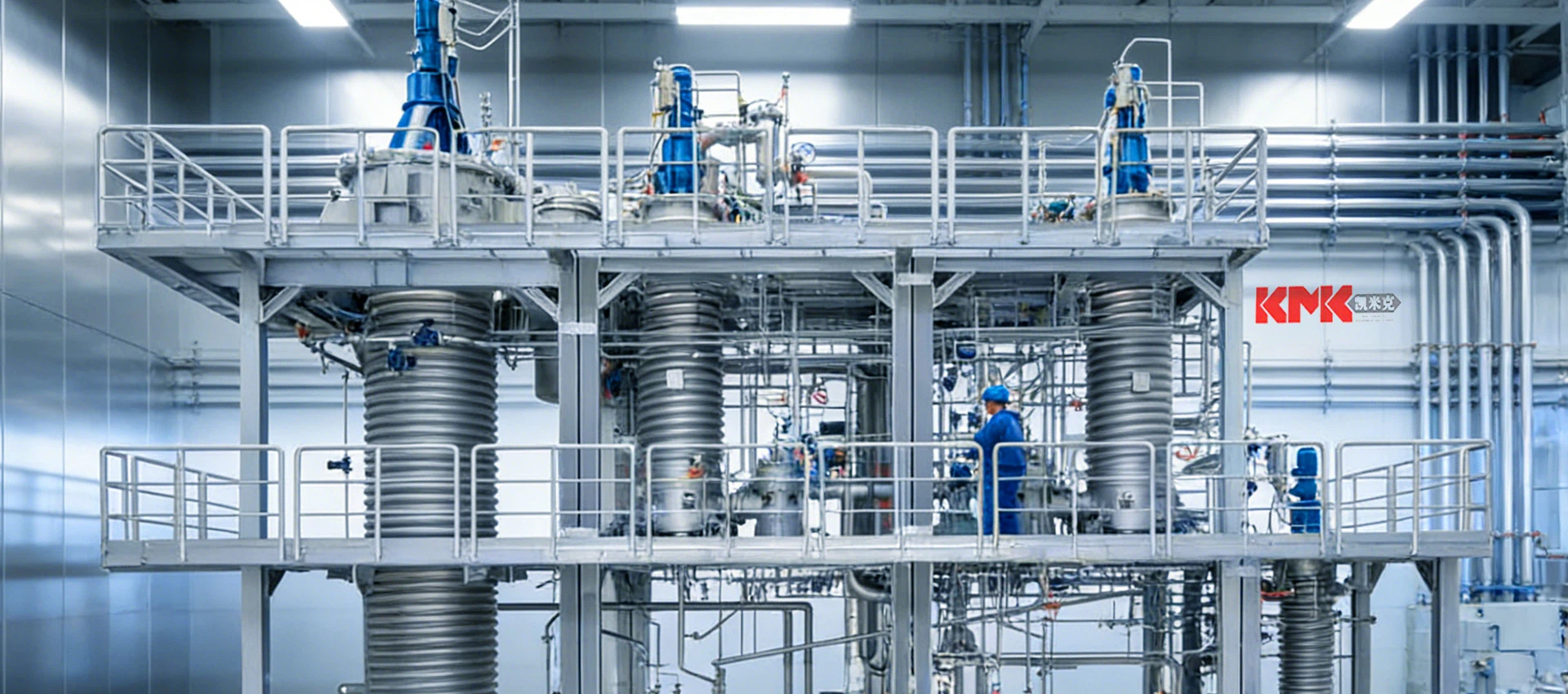
MVR evaporator working principle
Mar 15, 2020
Leave a message
The working process of the MVR evaporator is that the low-temperature steam is compressed by the compressor, the temperature and pressure increase, the enthalpy increases, and then enters the heat exchanger to condense to make full use of the latent heat of the steam. Except for start-up, no steam generation is required during the entire evaporation process. Except for start-up, no secondary steam from the evaporator is needed during the entire evaporation process. Compressed by the compressor, the pressure and temperature increase, the enthalpy increases, and then it is sent to the heating chamber of the evaporator to be used as heating steam. The feed liquid is maintained in a boiling state, and the heating steam itself is condensed into water. In this way, the steam to be discarded can be fully utilized, the latent heat is recovered, and the thermal efficiency is improved. The economics of steam generation is equivalent to 30 effects of multi-effect evaporation. Among them, in order to make the manufacturing of the evaporation device as simple and convenient as possible, a centrifugal compressor and a roots compressor can be used. These machines have a high volume flow in the compression ratio range of 1: 1.2 to 1: 2.
The compression cycle of a single-stage centrifugal compressor is depicted in an enthalpy-entropy diagram. Power required for single-stage centrifugal compressors: for example: compressing saturated water vapor from the evaporator from the suction state p1 = 1.9 bar, t1 = 119 ° C to p2 = 2.7 bar, t2 = 161 ° C (compression ratio Π = 1.4). The compression cycle follows the changeable curve 1-2, and the specific enthalpy of steam increases by Δhp. For the specific enthalpy h2 of the steam, the equation of the efficiency in the compressor (isentropic efficiency): at this temperature, it enters the heater of the evaporator. Based on the amount of steam inhaled, kg / hr. Variable unit of hp (effective) compression work, kJ / kg. hs unit isentropic compression work, kJ / kg.
The isentropic efficiency (internal efficiency) of the compressor is, among other factors, the unit variable work of compression hp depends on the multi-factor index κ and the molar mass M of the suction gas, as well as the suction temperature and the required pressure rise. For the actual coupling power of the prime mover (motor, gas engine, turbine, etc.), a larger mechanical loss margin is considered. The single-stage centrifugal compressor with impeller made of standard materials can obtain a water vapor pressure rise of a compression factor of 1.8. If a higher quality material such as titanium is used, the compression factor can be as high as 2.5. In this way, the final pressure p2 is 1.8 times the suction pressure p1, or a maximum of 2.5 times, which corresponds to a saturated steam temperature increase of about 12-18K, and the maximum temperature rise can reach 30K, which depends on the suction pressure. In terms of evaporation technology, it is common practice to express the pressure according to the corresponding boiling temperature of water. In this way, the effective temperature difference is directly expressed.
https://www.heczb.com