

Thermal Oil Mold Temperature Controller And Chiller
Description
Technical Parameters
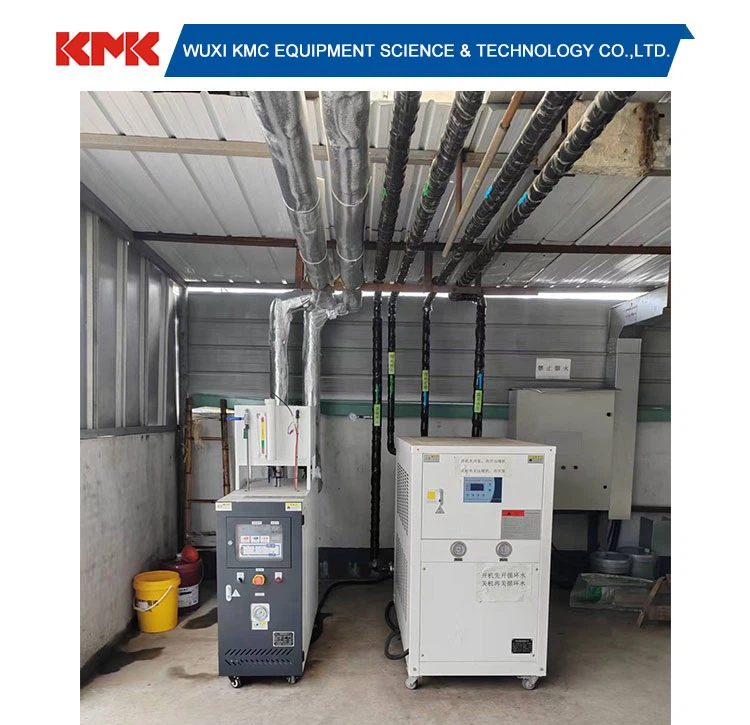
A thermal oil mold temperature controller uses thermal oil as a circulating medium to continuously heat and precisely control the temperature of molds or production equipment. Capable of providing temperatures significantly higher than those of water or steam, the Oil Type Mold Temperature Controller is a key component in high-temperature production processes.
A water chiller uses a refrigeration cycle to cool water or chilled water to the desired temperature. The chiller then pumps water to the equipment to remove heat, achieving rapid or constant temperature cooling.
Working Principle
- Working Principle of the Oil Heating Mold Temperature Controller
Heating: A built-in heater heats the thermal oil within the system.
Circulation: A high-temperature oil pump forces the heated thermal oil into the heat-consuming equipment.
Heat Exchange: The high-temperature thermal oil transfers heat to the mold, raising and maintaining the mold temperature at the set point.
Recirculation: After heat exchange, the cooled thermal oil returns to the mold temperature controller, where it is reheated and begins the next cycle, achieving continuous and stable temperature control.
- Working Principle of a Chiller
Refrigeration Cycle: Refrigerant circulates through four major components: the compressor, condenser, expansion valve, and evaporator.
Heat Endothermic Process: Low-temperature liquid refrigerant absorbs heat from the circulating water in the evaporator, evaporating into a gaseous state, thereby lowering the water temperature.
Heat Dissipation Process: After being compressed by the compressor, the gaseous refrigerant releases heat to the outside world in the condenser and condenses back into a liquid state.
Application Areas
- Core Features and Advantages of Chillers
Efficient Cooling: Quickly and forcefully removes heat from equipment or molds, significantly shortening product cooling time and improving production efficiency.
Stable Temperature: Maintains a constant cooling medium temperature, preventing product quality fluctuations caused by water temperature fluctuations.
Water-Saving and Environmentally Friendly: Compared to using tap water directly, this closed-circuit system conserves significant water resources.
Improved Product Quality: Rapid and uniform cooling reduces internal stress in products, preventing defects such as deformation and shrinkage, and improving surface finish.
Various Types: Available in air-cooled and water-cooled models, chillers are suitable for different installation environments and water resource conditions.
- Core Features and Advantages of Oil Heating Mold Temperature Controllers
High-Temperature Performance: Maximum temperatures can reach 300°C, 350°C, and even 400°C, meeting the demands of high-temperature processes.
Precise Temperature Control: Utilizing PID intelligent control, temperature control accuracy can reach ±0.5°C or higher, ensuring stable product quality.
Low Operating Pressure: At high temperatures, the saturated vapor pressure of thermal oil is much lower than that of water, ensuring safer system operation.
Closed-Circuit Circulation: The thermal oil circulates in a closed system, making it less susceptible to oxidation and volatilization, resulting in a long service life and low energy consumption.
Comprehensive Safety Protection: Control Unit Mold Temperature Controllers typically feature multiple safety features, including over-temperature protection, fluid shortage protection, abnormal pressure protection, and phase loss and reverse phase protection.
why choose us
A high-tech enterprise specializing in the research, development, design and manufacturing of chemical equipment such as reaction equipment, distillation equipment, evaporation equipment, crystallization equipment, etc.
With years of industry experience and technological innovation, KMK equipment engineers focus on designing chemical equipment such as reaction, distillation, evaporation, and crystallization, which are widely used in petrochemical, pharmaceutical, fine chemical, food, biology, oil, flavor, environmental protection and other industries.
As a leading manufacturer of chemical equipment such as reaction equipment, distillation equipment, evaporation equipment, crystallization equipment, we are committed to providing customers with efficient, reliable and durable fine chemical equipment solutions.
Our company has a 200 square meter laboratory and can provide small-scale test equipment such as distillation towers, scraped film evaporation, molecular distillation, gas stripping, drying, crystallization, etc. After years of research and development, design, manufacturing and engineering system integration, we have accumulated considerable experience and have now developed into a professional company that provides one-stop services such as research and development design, manufacturing, installation, instrument automation, commissioning, and training.


Hot Tags: thermal oil mold temperature controller and chiller, China thermal oil mold temperature controller and chiller manufacturers, suppliers, factory, Oil Heating Mold Temperature Controller, Oil Type Mold Temperature Controller, Control Unit Mold Temperature Controller
Previous
No InformationSend Inquiry


